

 Go to live demo
Many growing manufacturers assume that implementing an ERP system is the next logical step in their digital transformation journey. While ERP systems are undeniably powerful, they can also be overly complex, costly, and time-consuming — particularly for small to medium-sized manufacturers (SMBs) that are just beginning to modernize operations.
For most SMBs, starting with a Manufacturing Resource Planning (MRP) system provides a faster, leaner, and more practical path to gaining control over production and inventory. Instead, these systems offer a staged approach that lays a foundation for future digital growth—while reducing disruption, spreading out costs, and keeping teams focused on daily operations. Read on to learn more about how MRP systems and their staged adoption approach can set SMBs up for success quickly and generate value over the long term.
Understanding the Difference Between MRP and ERP
Like an ERP system, an MRP system provides small to medium-sized manufacturers with essential tactical production management capabilities by streamlining how materials, inventory, and scheduling are handled on a daily basis. It helps ensure that the right materials are available at the right time by aligning procurement and inventory levels with actual production demand. MRP systems automate job scheduling, manage work orders, and provide visibility into shop floor activity, enabling manufacturers to reduce stockouts, minimize waste, and improve delivery performance. Typically, MRP systems do not force users to immediately adopt the system in its entirety to find value. Instead, these systems allow SMBs to add functionality at their own pace, or as growth requires it.
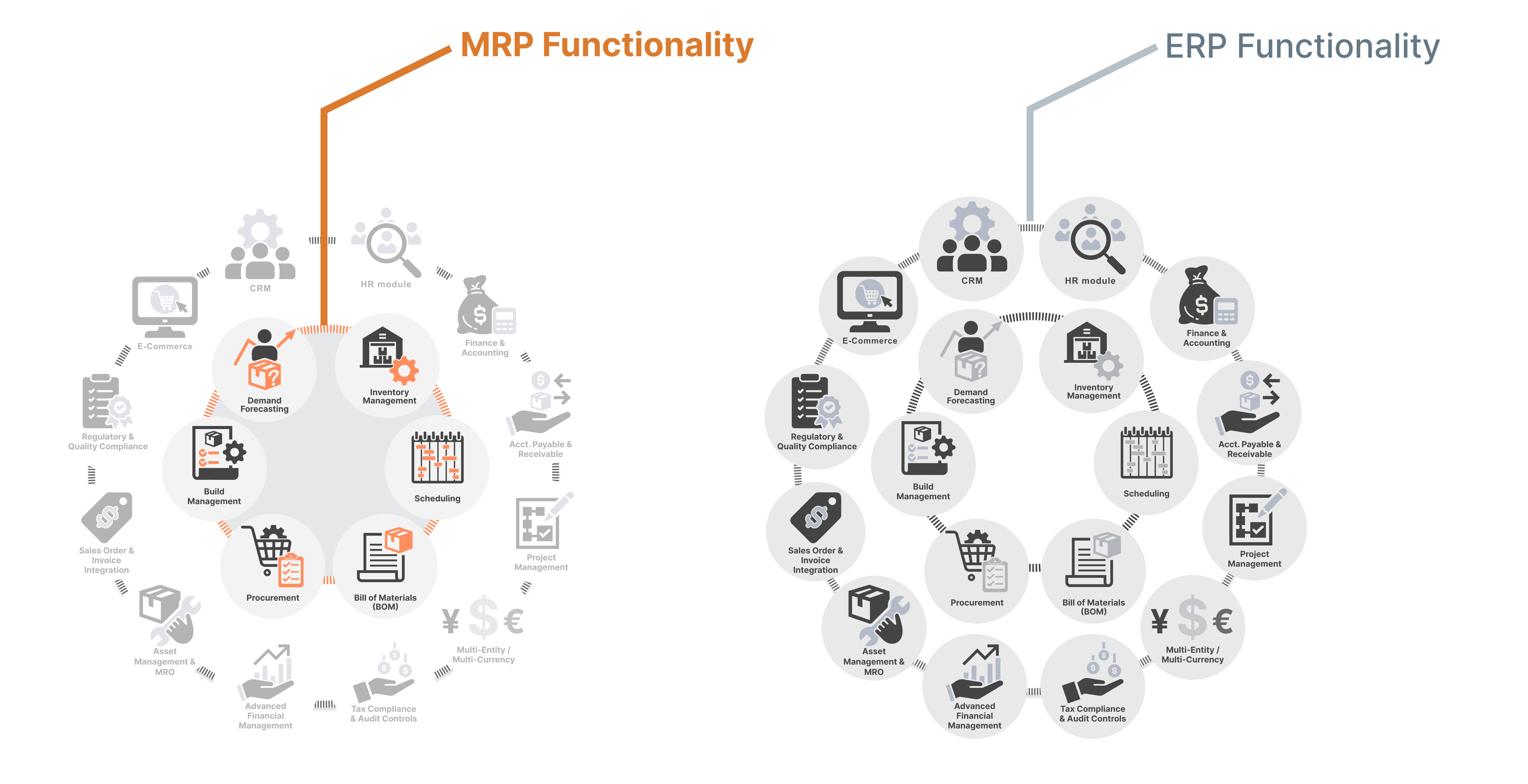
In contrast, ERP systems offer expansive enterprise-level functionality that extends well beyond the core needs of most SMB manufacturers, encompassing areas like multi-entity financial consolidation, advanced human resource management, customer relationship management, supply chain logistics, and compliance tracking across global operations. While these capabilities are valuable investments for large, complex organizations, they often introduce unnecessary complexity and overhead for SMBs that are primarily focused on streamlining production, managing inventory, and meeting customer orders efficiently.
Why Adopting ERP Too Early Could be Damaging for SMBs
Implementing a full ERP suite can overwhelm smaller teams with features they don’t need, require significant customization, and divert resources away from immediate operational improvements — making it an ill-fitting solution for companies still building their digital foundation.
SMBs can quickly become overwhelmed by the demands of ERP long before they see any meaningful return. One of the most immediate challenges is the high upfront cost. Licensing fees, setup expenses, employee training, and system customization quickly add up, often requiring a significant capital investment that can strain already tight budgets. Unlike MRP systems, which are more focused and lightweight, ERP platforms demand substantial resources just to get off the ground, even before they begin generating value.
Compounding this is the issue of long implementation times. Rolling out an ERP system is not a quick process. It can take months or even years to fully configure, integrate, and deploy across all departments. For SMBs focused on maintaining daily production schedules and meeting customer demand, this extended timeline can disrupt operations and create uncertainty. During this period, managers may be forced to juggle the pressures of implementation while still relying on inefficient legacy systems, ultimately delaying ROI and creating frustration among staff.
Once the system is in place, many SMBs face low adoption rates, especially among frontline teams. ERP systems often come with an overwhelming array of features and interfaces designed for enterprise-scale needs. For employees who are used to more manual or simplified systems, this complexity can lead to confusion, resistance, and rejection. If staff view the software as irrelevant to their daily tasks or overly complicated, they may bypass it entirely, resulting in data inaccuracies, communication breakdowns, and underutilized technology.
Even when successfully implemented, ERP systems bring high ongoing operational costs. Monthly or annual licensing fees, mandatory support packages, and the need for dedicated IT staff to manage, troubleshoot, and update the platform can significantly eat into margins. For an SMB operating on lean budgets and minimal headcount, maintaining such infrastructure can be a continuous burden. Ultimately, the mismatch between the scale of ERP systems and the immediate needs of SMBs can create more risk than reward — making a leaner, more tactical approach like MRP a safer and smarter first step.
The Smarter Path: A Phased Adoption Roadmap with MRP
Instead of a disruptive, all-at-once rollout typically found with ERP migrations, a phased MRP system adoption lets manufacturers focus on implementing core functions like inventory visibility or production scheduling first — areas that quickly demonstrate value and build momentum.
Breaking MRP adoption into four manageable stages allows SMBs to achieve faster wins, gain better operational control, and drive higher team buy-in by aligning each step with immediate business needs. Each successful stage creates measurable improvements, builds team confidence, and reduces resistance to change by introducing tools that feel relevant and manageable. This gradual progression not only minimizes operational risk but also ensures that staff have time to learn, adapt, and fully adopt each capability before moving on to the next, leading to a more sustainable and effective digital transformation.
Below, we have created an example roadmap for a four-stage MRP system rollout to help SMBs visualize the process. Each stage could comfortably be executed in three month time periods to ensure not only the data transition is handled properly but enough time is provided to further ensure those affected by the migration are trained and comfortable with the new processes.
Four Stage MRP Roadmap Example

Step 1: Part and BOM Data Management
Organize the fundamental data: parts, materials, and Bills of Materials (BOMs).
- Clean BOMs are the foundation of all future production planning.
- Centralizing this data eliminates version control issues and errors in spreadsheets or paper-based systems.
Value Delivered:
- Immediate clarity in what parts are used where.
- Avoids miscommunications between engineering, purchasing, and production.

Step 2: Inventory, Production, and Basic Demand Management
Once your data is organized, layer on real-time inventory tracking and production scheduling.
- These are the biggest pain points for most SMBs: stockouts, delays, and reactive firefighting.
- With BOMs in place, you can now see actual material requirements and production timing.
Value Delivered:
- Reduced inventory guesswork and stockouts.
- Gain visibility into what’s available, what’s in process, and what’s late from a single dashboard.
- Start aligning production schedules with real demand.

Step 3: Purchasing and Vendor Management
With production running more predictably, the next step is standardizing the purchasing process in the system and managing supplier performance.
- The MRP system should be able to highlight what materials are needed and when.
- Reduce manual PO creation and vendor tracking bottlenecks.
Value Delivered:
- Reduce missed buys and late orders with organization-wide demand visibility.
- Track lead times, minimum order quantities, and delivery reliability from one location.
- Build better supplier relationships with accurate data.

Step 4: Quality Management
Integrate quality processes and controls into your now-stabilized MRP operations.
- Quality issues become easier to trace once quality processes are standardized in an integrated system with inventory and production.
- You now have the data and processes in place to develop quality metrics and tie them to specific materials, processes, and vendors.
Value Delivered:
- Set up nonconformance tracking, inspection steps, and supplier quality ratings.
- Reduce rework, scrap, and customer complaints.

While the staged MRP rollout example shown here may not align for all organizations’ processes, the path to a purpose-built manufacturing management system doesn’t have to begin with a monolithic ERP system integration. By migrating to an MRP system on your own terms and time table, you can generate immediate, measurable value while giving your team time to adapt and grow with the system.
Making the Right Choice
As with all major decisions, it is important to think slowly and fully understand what complexities your organization needs to manage without adding new issues. Even though it may appear as though ERP systems are the industry standard, for many SMBs, they bring more complexity and cost than value.
Instead, start with what your operations truly need: an MRP system like Aligni that delivers structure, visibility, and control without the heavy overhead. As your business scales and your needs evolve, you’ll be in a stronger position to expand functionality and, when the time is right, layer in the advanced ERP capabilities that support enterprise-level management—but on your own terms and timeline.
Ready for a Smarter Rollout?
Aligni is the MRP system built specifically for small and mid-sized electronics manufacturers.
Start with the tools you need now—like BOM management, inventory visibility, and production scheduling—and scale up on your terms.
No bloated ERP rollout. No disruption. Just clarity, control, and momentum.